 By James Purse, Director at Project7 · Last reviewed 13 November 2026 · 3 minute read
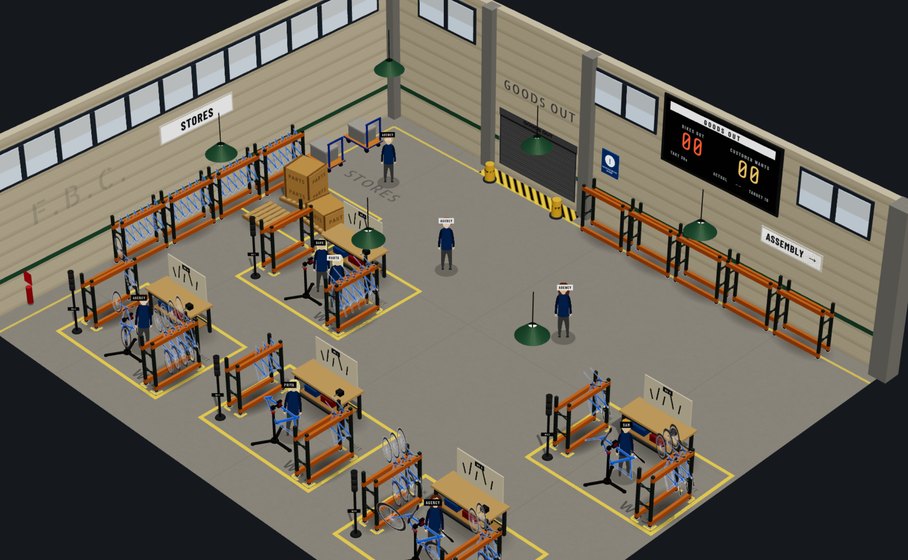
Short answer. Lean Simulator has four kinds of role on its bicycle line: assemblers at five workstations, material handlers who move parts and batches, an inspector who checks finished bikes, and a storesperson who issues parts. Players take the roles; the simulation works any role nobody takes. Some roles change, or disappear, as the line improves.
Key facts
- Assemblers: five workstations, each fitting its own parts in sequence.
- Material handlers: move parts and batches around the line in the early shifts.
- Inspector: checks bikes at the end of the line until quality is built in at Shift 4.
- Storesperson: issues parts from Stores.
- Empty roles: worked by the simulation at a human pace.
| Role | What you do | How it changes |
|---|---|---|
| Assembler (workstations 1 to 5) | Pick the right parts from your bin and fit them to the bike in front of you. Watch for lookalike parts. | In Shift 1 you cannot move parts or check your own work. From Shift 2 you pass work directly to the next station; from Shift 4 you check quality yourself. |
| Material handler | Carry parts from Stores and batches between stations. | Very busy in Shift 1, when Stores is far away. Much less walking once the line is laid out in sequence. |
| Inspector | Check finished bikes and send faulty ones back for rework. | Disappears in Shift 4, when assemblers build quality in at source. |
| Storesperson | Issue parts from Stores to the line. | In Shift 1 Stores is behind a wall and down a corridor, out of sight of the line. From Shift 2 it sits next to the line. |
Getting started in your role
Every player starts in Shift 0, the induction. You get a private briefing from Evan about your role, then a short drill on a practice floor with no clock and no score. An audio-guided tour spotlights each control the first time you need it. When you are ready, you tick your ready flag and the host can start Shift 1.
Why the roles feel the way they do
Shift 1 is designed so every role is frustrated in a different way. Assemblers wait for parts they are not allowed to fetch. Handlers walk constantly. The inspector is swamped. The storesperson cannot see what the line needs. That spread of frustration is deliberate: in the debrief each person can describe a different kind of waste.
Frequently asked questions
Four to eight is ideal. With fewer, the simulation works the empty roles, so even one person can play.
Yes. The host can reassign roles between shifts or mid-shift.
From Shift 4, assemblers check their own work. That is quality at source: building it in instead of inspecting it out.
Try it before you run it
Work one shift on the line with Evan guiding you. It needs only your email address: no card and no contract.
Related guides
- How to join a Lean Simulator game
- Shift 0: the induction
- Shift 1: Push and Batch
- Shift 4: One-Piece Flow and Quality at Source
About the author
James Purse is a Director at Project7, a UK operational transformation consultancy whose approach is grounded in Toyota thinking, and has nearly 20 years of practitioner experience in Lean, leadership and performance improvement. He works with manufacturing, engineering and infrastructure organisations to find what is really limiting performance and to fix it alongside their own teams. James Purse on LinkedIn