 By James Purse, Director at Project7 · Last reviewed 13 November 2026 · 3 minute read
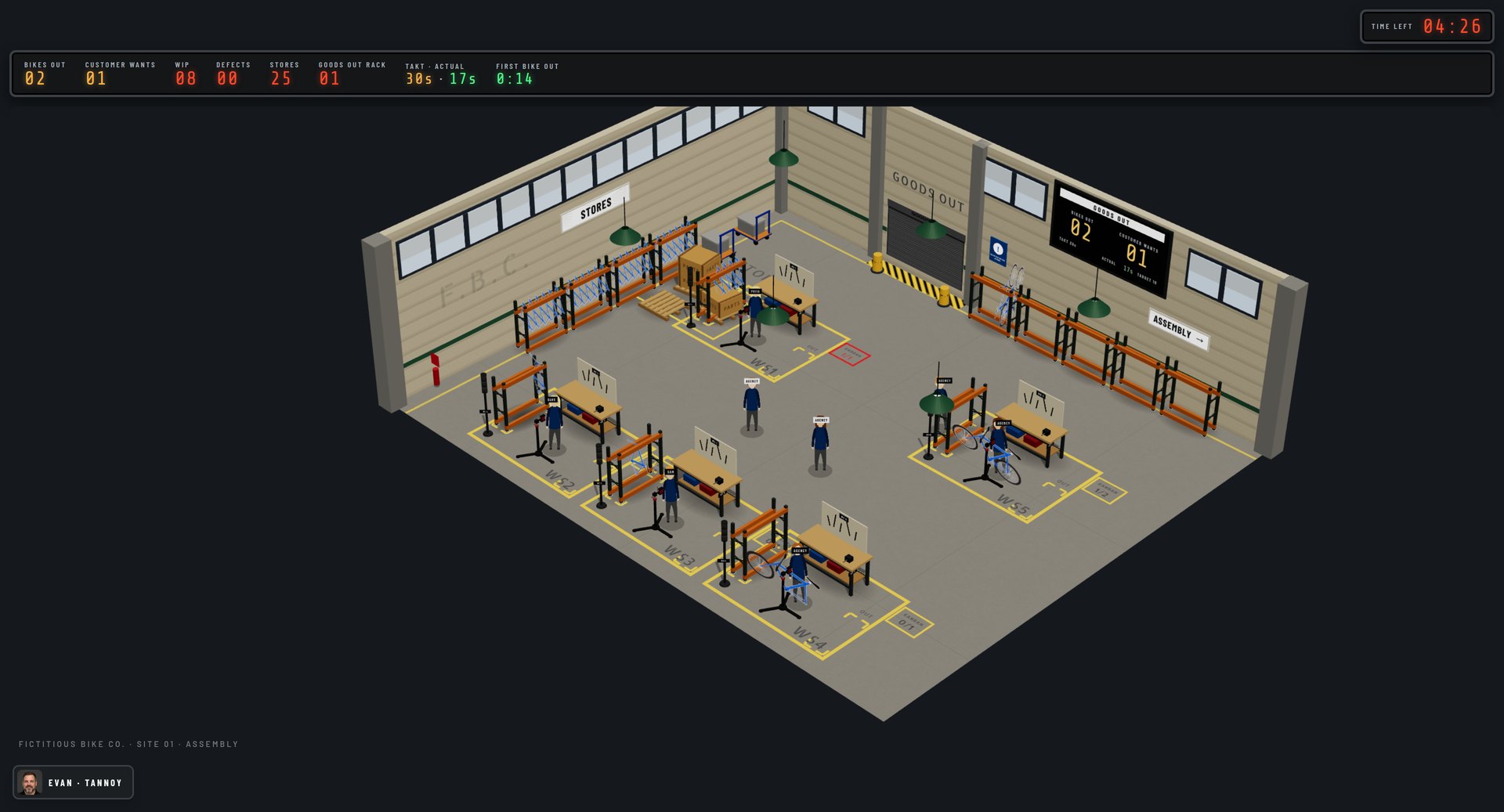
Short answer. Shift 3 introduces pull with a kanban of three. Kanban squares cap how much each station can hold for the next one, so you stop building when your customer needs nothing, even with parts in front of you. Work in progress is capped and the line starts responding to demand instead of pushing to it.
Key facts
- Kanban: three per square.
- Rule: build only when the square downstream has space.
- Effect: work in progress capped.
What changes on the line
- Kanban squares mark the space for finished work at each station.
- A station may only build when its downstream square has room.
The Lean idea: pull versus push
In a pull system the next step signals what it needs, and nothing is built until it is needed. Kanban is the signal: an empty space means build one more.
Stopping with parts in front of you feels wrong at first. But it caps the stock in the line, shortens the time each bike spends waiting, and exposes the real bottleneck.
What to watch for
- People hesitating when the square is full.
- Work in progress falling compared with Shift 2.
- The station where work queues: the bottleneck.
Debrief questions
- How did it feel to stop with parts in front of you?
- What happened to the stock in the line?
- Which station held everyone up?
For the full debrief method, see How to debrief a Lean simulation.
Facilitator tips
- Expect some resistance to stopping; it is the point of the shift.
- If the team picks the trap card to drop the squares, let the detour run.
Frequently asked questions
Kanban is a visual signal, such as a card or a marked square, that tells the previous step to make or move more. It limits work in progress and creates pull.
Push builds to a plan regardless of need. Pull builds only when the next step or the customer signals a need.
Try it before you run it
Work one shift on the line with Evan guiding you. It needs only your email address: no card and no contract.
Related guides
- Shift 2: Layout and Flow
- Shift 4: One-Piece Flow and Quality at Source
- The six-shift journey
- How to debrief a Lean simulation
About the author
James Purse is a Director at Project7, a UK operational transformation consultancy whose approach is grounded in Toyota thinking, and has nearly 20 years of practitioner experience in Lean, leadership and performance improvement. He works with manufacturing, engineering and infrastructure organisations to find what is really limiting performance and to fix it alongside their own teams. James Purse on LinkedIn