 By James Purse, Director at Project7 · Last reviewed 13 November 2026 · 3 minute read
Short answer. Shift 2 rearranges Lean Simulator’s line for flow: stations are placed in process order, stores move next to the line and assemblers pass work directly to the next station. Batches are still six. The line takes less floor space and far less walking, and it usually starts making money.
Key facts
- Layout: a cell of five stations in process order, 268 m².
- Stores: next to the line.
- Batch size: still six.
- Typical result: the line moves from loss to profit.
What changes on the line
- Stations placed in the order the bike is built.
- Stores brought next to the line.
- Assemblers pass their own batches to the next station.
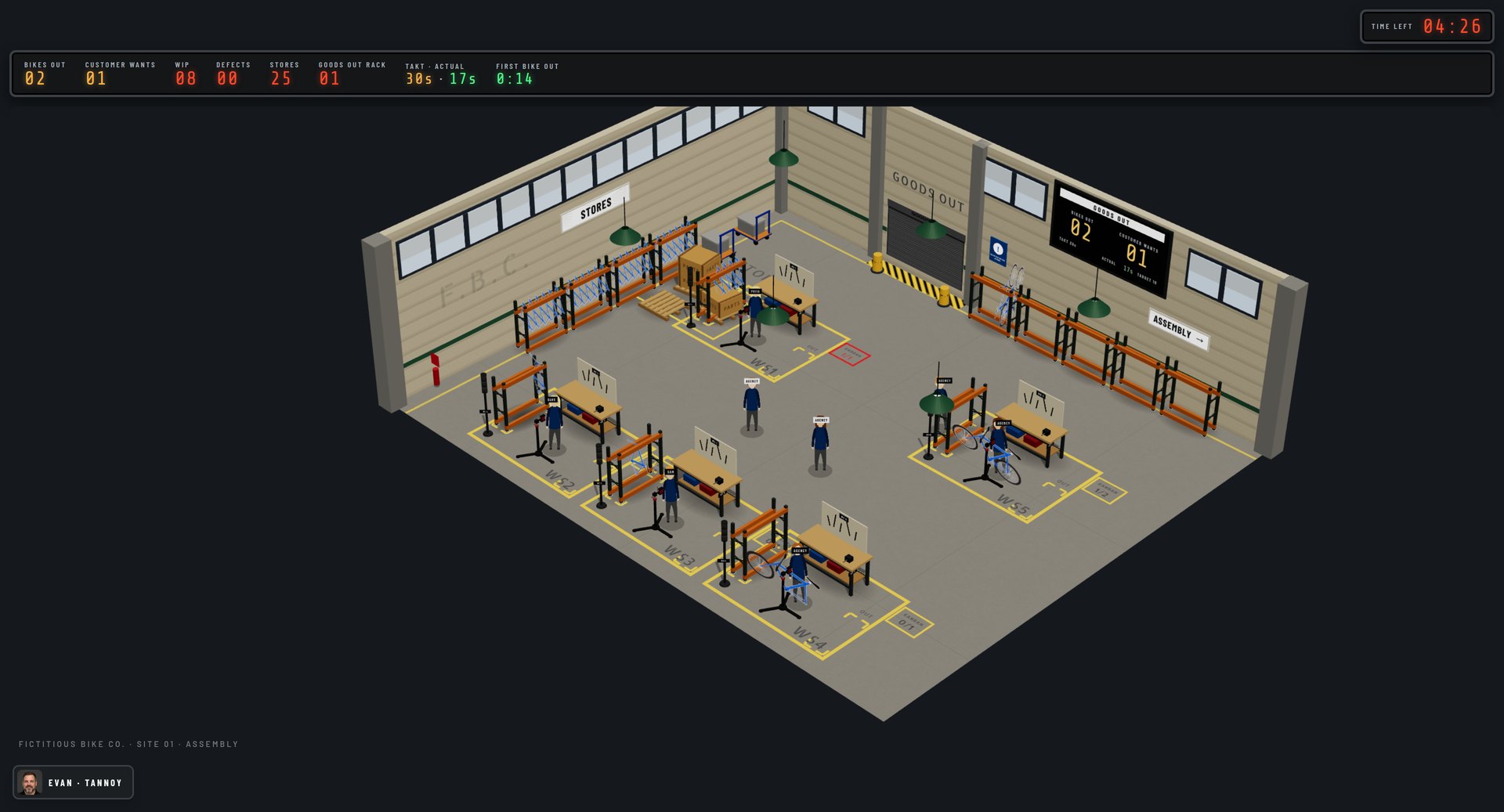
The Lean idea: layout design and flow
Transport and motion add no value. Laying stations out in process order removes most of the walking and handling, and frees the people who did it.
Flow improves, but the batch of six remains, so stock still piles up between stations. That leftover problem sets up the next shift.
What to watch for
- Floor space falling from 390 m² to 268 m².
- Handlers with much less to do.
- Stock still collecting between stations because of the batch size.
Debrief questions
- How much walking disappeared?
- What still piles up, and why?
- What would you change next?
For the full debrief method, see How to debrief a Lean simulation.
Facilitator tips
- Point out that the people and the work are the same; only the layout changed.
- Ask why the batch size is still a problem.
Frequently asked questions
A cell places the steps of a process next to each other in order, so work flows from one to the next with little transport or waiting.
The batch size is still six, so each station finishes six before passing them on.
Try it before you run it
Work one shift on the line with Evan guiding you. It needs only your email address: no card and no contract.
Related guides
- Shift 1: Push and Batch
- Shift 3: Pull with Kanban
- The six-shift journey
- How to debrief a Lean simulation
About the author
James Purse is a Director at Project7, a UK operational transformation consultancy whose approach is grounded in Toyota thinking, and has nearly 20 years of practitioner experience in Lean, leadership and performance improvement. He works with manufacturing, engineering and infrastructure organisations to find what is really limiting performance and to fix it alongside their own teams. James Purse on LinkedIn