 By James Purse, Director at Project7 · Last reviewed 13 November 2026 · 3 minute read
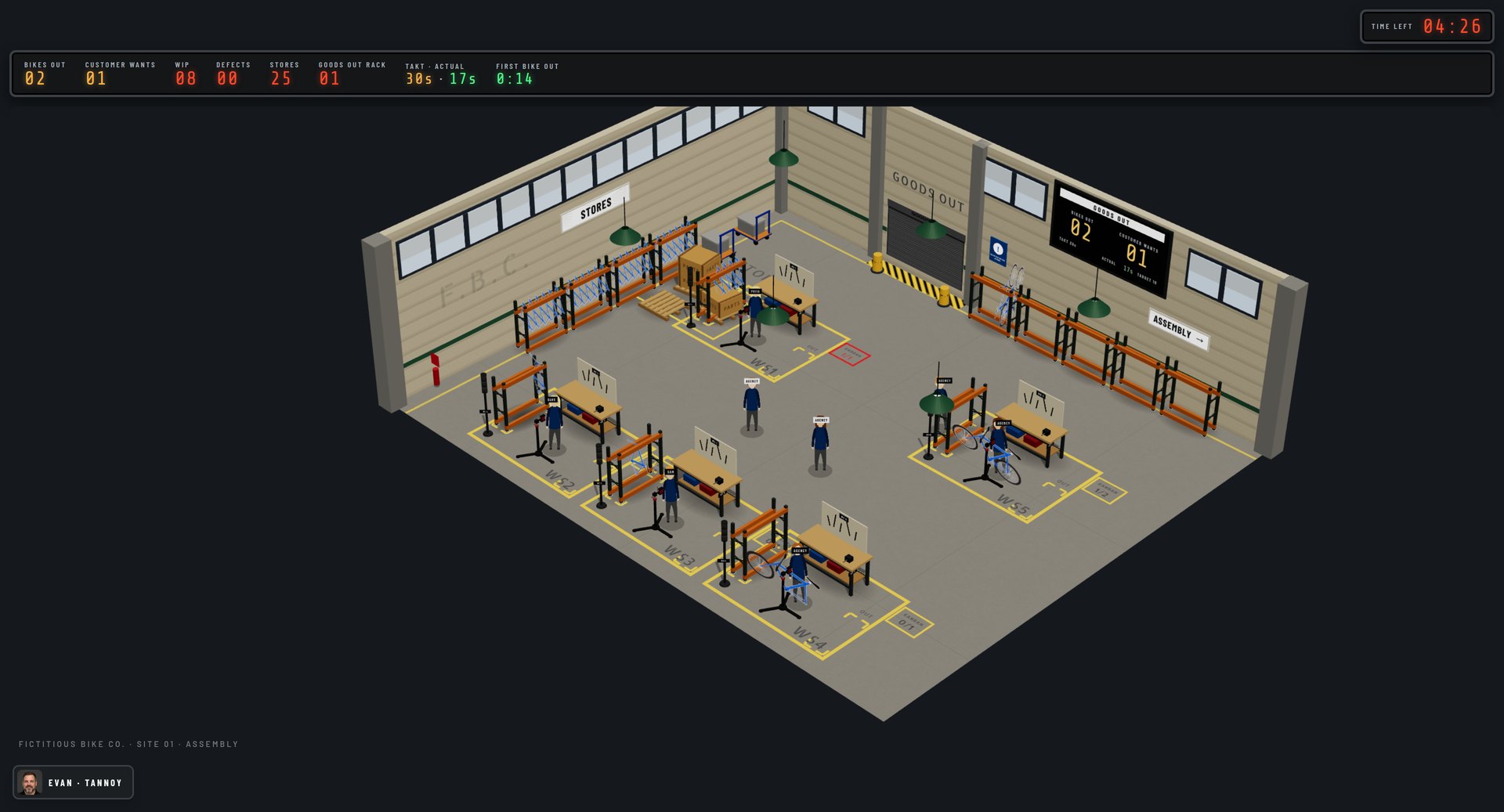
Short answer. Lean Simulator’s six-shift journey takes a team from a wasteful push-and-batch line to a balanced, levelled cell, one Lean lever at a time. After a short induction, each ten-minute shift changes one thing: layout, pull, batch size and quality, balance, then takt time. Shorter two-shift journeys cover a single idea.
Key facts
- Length: about ten minutes per shift on the clock; the full journey is usually a half day.
- Structure: induction, then six shifts, each with a briefing and a debrief.
- Between shifts: the team chooses its next change from three decision cards.
- Short journeys: Batch Size Impact and Layout and Flow, two rounds each.
| Shift | What changes | Lean idea |
|---|---|---|
| Shift 0: Induction | Practice floor, no clock, no score | Fair starting point |
| Shift 1: Push and Batch | Spread layout, remote stores, batches of six, inspection at the end | The starting point |
| Shift 2: Layout and Flow | Stations in process order, stores close, work passed directly | Layout design |
| Shift 3: Pull with Kanban | Kanban squares of three cap each downstream rack | Pull versus push |
| Shift 4: One-Piece Flow and Quality at Source | Batch of one, kanban of one, no inspector | One-piece flow; building quality in |
| Shift 5: Balance the Line | Work rebalanced at the bottleneck station | Line balancing |
| Shift 6: Takt and Levelled Scheduling | Demand falls 40%, three operators | Takt time and levelled scheduling |
Why the order matters
Each shift builds on the one before. Layout comes first because flow is impossible while people walk between scattered stations. Pull comes next to cap the stock that flow alone cannot stop. One-piece flow and quality at source then cut lead time, balancing removes the bottleneck, and takt time sets the pace to match demand.
Shorter journeys
- Batch Size Impact (two rounds): the same line with large and then small batches. Use it to show why batching delays the customer.
- Layout and Flow (two rounds): the spread-out line and then the sequenced cell. Use it to show the cost of transport and handling.
Frequently asked questions
Six, after a short induction. Two-shift journeys are also available for a single idea.
Hosts follow the journey in order so each shift's results compare fairly with the last. The two-shift journeys are the way to run a shorter session.
Layout design, pull versus push, one-piece flow versus batching, quality at source, line balancing, takt time and levelled scheduling.
Try it before you run it
Work one shift on the line with Evan guiding you. It needs only your email address: no card and no contract.
Related guides
- How to run a Lean simulation workshop
- Session plans for a Lean simulation workshop
- Shift 1: Push and Batch
About the author
James Purse is a Director at Project7, a UK operational transformation consultancy whose approach is grounded in Toyota thinking, and has nearly 20 years of practitioner experience in Lean, leadership and performance improvement. He works with manufacturing, engineering and infrastructure organisations to find what is really limiting performance and to fix it alongside their own teams. James Purse on LinkedIn