 By James Purse, Director at Project7 · Last reviewed 13 November 2026 · 3 minute read
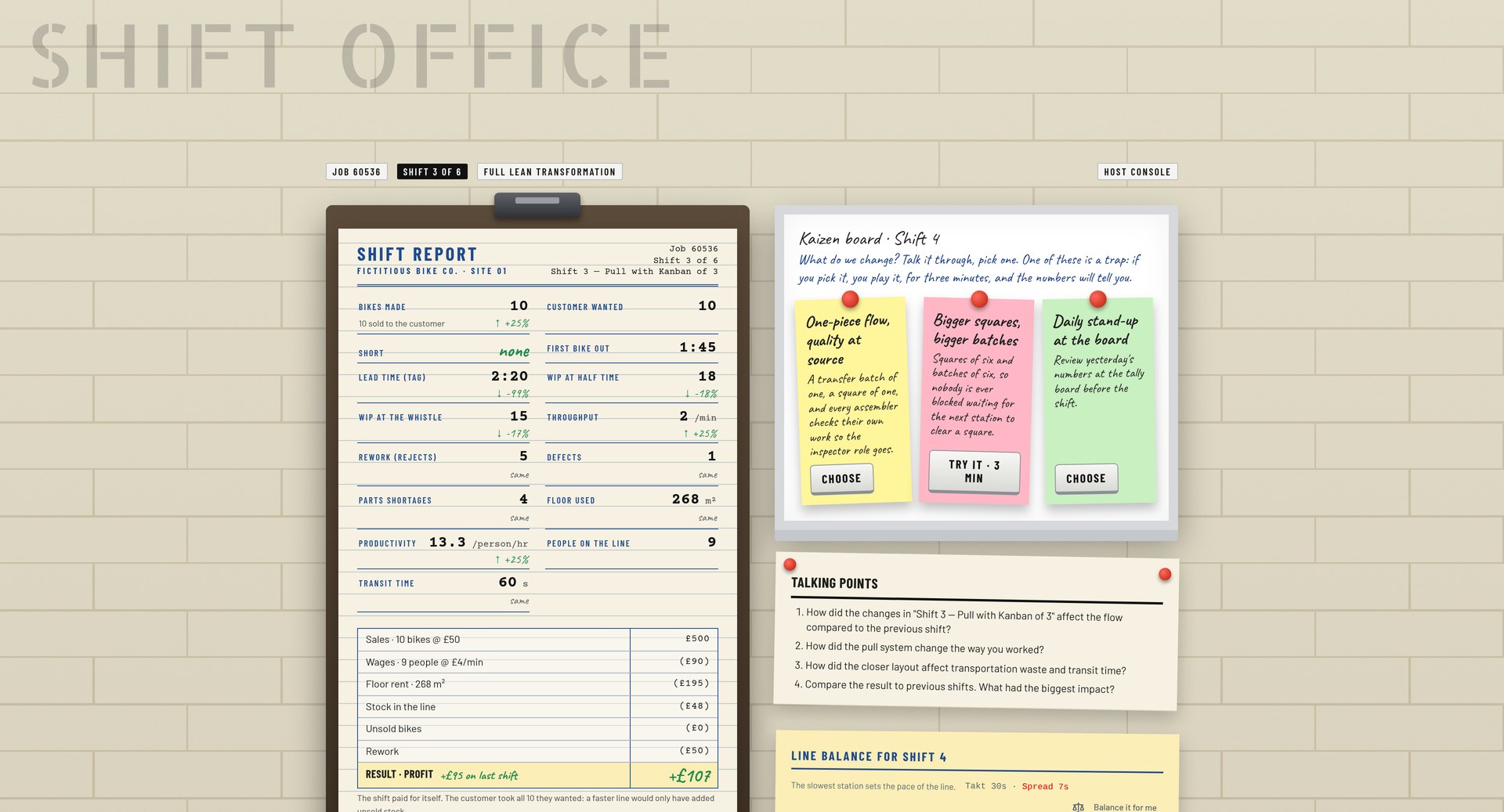
Short answer. Lean Simulator scores every shift on work in progress, time to first delivery, the lead time of a tagged frame, bikes made, floor space and a profit or loss. Work in progress, first delivery and lead time show the effect of the line’s design most clearly, because they depend much less on how fast people work than bikes made does.
Key facts
- Work in progress (WIP): half-built product in the line, measured at half time and tracked over the shift.
- First delivery: how long the customer waits for the first finished bike.
- Lead time: how long a red-tagged frame takes to travel from entering the line to Goods Out.
- Profit or loss: sales less wages, floor rent, stock, unsold bikes and rework.
- Bikes made: useful, but sensitive to pace.
The measures
| Measure | What it tells you | Depends on pace? |
|---|---|---|
| Work in progress at half time | How much stock is tied up in the line. High WIP hides problems and delays everything behind it. | Little |
| First delivery | How quickly the line starts serving the customer. Big batches make the customer wait. | Little |
| Tagged frame lead time | A red-tagged frame enters after 60 seconds and is timed at every station until Goods Out. It shows how long one bike really takes. | Little |
| Floor space | The area the line occupies, which drives floor rent. | No |
| Rework | Bikes sent back for faults. | Some |
| Bikes made | Finished bikes collected by the customer at Goods Out. | Yes |
How the profit or loss is worked out
Every shift ends with a simple statement of sales, costs and profit or loss, in the game’s own money:
| Item | Value |
|---|---|
| Sales | 50 for each bike sold |
| Wages | 2 per person per minute |
| Floor rent | 0.5 per square metre per shift |
| Stock in the line | 2 per part |
| Unsold bikes | 5 each |
| Rework | 10 per bike reworked |
Floor space changes with the layout: the spread-out Shift 1 line uses 390 m², a cell of five stations uses 268 m² and a cell of three uses 179 m². At a standard pace Shift 1 usually loses around 60 to 85, and the redesigned line makes money from Shift 2.
Reading the journey summary
The journey summary puts every shift side by side. The story to look for: work in progress and lead time fall sharply, floor space shrinks, the first bike arrives sooner and the loss turns into a profit, and in Shift 6 output per person holds up even with fewer operators.
Frequently asked questions
Work in progress is product that has been started but not finished. In Lean, high WIP is a form of waste: it ties up money and space and hides problems.
Lead time is the total time one item takes to pass through the whole process. Cycle time is how often a finished item comes off the end of the line.
Large batches, a spread-out layout and late inspection mean high stock, high floor rent, rework and few bikes reaching the customer within the shift.
Try it before you run it
Work one shift on the line with Evan guiding you. It needs only your email address: no card and no contract.
Related guides
About the author
James Purse is a Director at Project7, a UK operational transformation consultancy whose approach is grounded in Toyota thinking, and has nearly 20 years of practitioner experience in Lean, leadership and performance improvement. He works with manufacturing, engineering and infrastructure organisations to find what is really limiting performance and to fix it alongside their own teams. James Purse on LinkedIn