 By James Purse, Director at Project7 · Last reviewed 13 November 2026 · 4 minute read
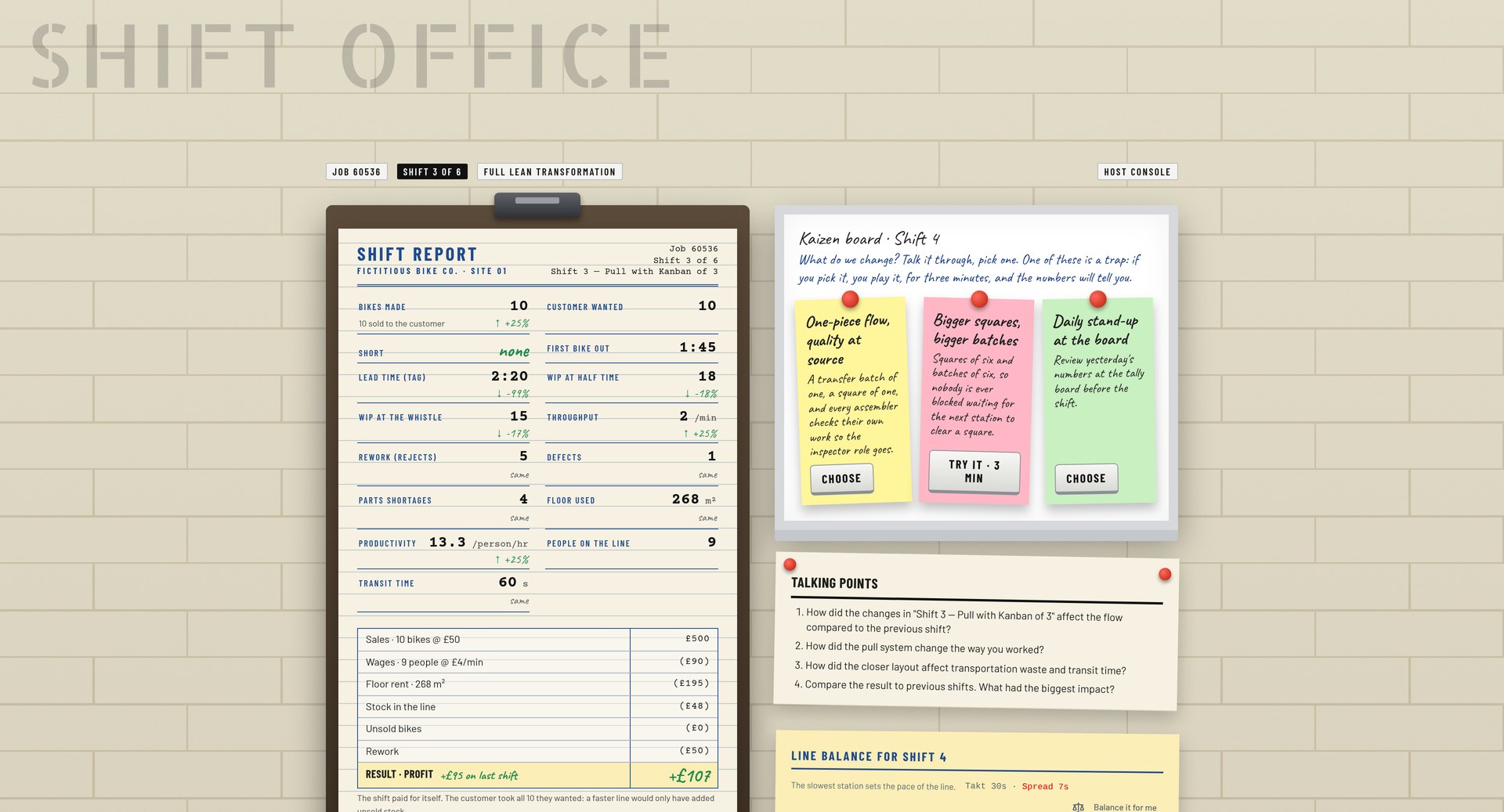
Short answer. To debrief a Lean simulation, start with what the numbers show, ask why it happened, connect it to the group’s own work, then agree the next change. In Lean Simulator, lead with work in progress, first delivery and lead time rather than bikes made, and let the team choose its next change from three decision cards.
Key facts
- When: straight after each shift, in the shift office.
- Lead with: work in progress at half time, first delivery and the tagged frame’s lead time.
- Then: the profit or loss, and bikes made with care.
- Close with: a decision card for the next shift, and one link to real work.
A four-step debrief
- What happened? Read the numbers together. Ask each role what it felt like.
- Why? Trace the numbers to causes: where stock built up, where people waited, where defects were found.
- Where have you seen this? Ask for one example from the group’s own workplace.
- What will we change? Choose the next lever from the decision cards.
Why bikes made comes last
A quick team can build more bikes in a bad system, and a slower team fewer in a good one. Work in progress, first delivery and lead time depend much less on pace, so they show the effect of the design. Reading the results: WIP, lead time and profit explains each measure.
Questions by shift
| Shift | Questions to ask |
|---|---|
| 1. Push and Batch | Where did you wait? Where did half-built bikes pile up? How long did the customer wait for the first bike? |
| 2. Layout and Flow | How much walking disappeared? What still piles up between stations? Why is the batch still a problem? |
| 3. Pull with Kanban | How did it feel to stop with parts in front of you? What happened to the stock in the line? |
| 4. One-Piece Flow and Quality at Source | What happened to the tagged frame’s lead time? What changed when you checked your own work? |
| 5. Balance the Line | Who was waiting, and who was overloaded? What changed when the work was rebalanced? |
| 6. Takt and Levelled Scheduling | How did fewer people keep up with demand? Where would you redeploy the people freed up? |
Using the decision cards
At the end of shifts 1 to 5 the team picks its next change from three cards: the intended Lean lever, a neutral card that sounds sensible but changes nothing, and a trap. If the team picks the trap, the line runs a three-minute detour so they can see the result, and Evan debriefs it against the shift it came from. There is one detour per session. Traps that look reasonable but backfire include:
- Stock up every station: work in progress rises about 2.7 times for the same output.
- Batches of twelve: nothing reaches the customer during the detour.
- Bigger kanban squares and batches: work in progress doubles and the first bike arrives later.
- Drop the kanban squares: twice as many bikes built, the same number sold, and unsold stock left over.
- Build ahead: a profit can swing to a loss.
Do not steer the team away from a trap. Choosing one and seeing it fail is often the most memorable moment of the session.
If Evan is leading
In self-paced sessions Evan runs the debrief as reflection prompts. With a facilitator present, let Evan present the numbers and the Lean idea, then take over for the questions about the group’s own work.
Frequently asked questions
Around ten to fifteen minutes. Allow longer after Shift 1 and Shift 4, where the biggest changes happen.
Work in progress, the time to first delivery and the lead time of a single tagged item. Throughput is useful but depends on how fast people work.
Let it run. The three-minute detour shows why the idea backfires, and Evan debriefs it against the previous shift.
Try it before you run it
Work one shift on the line with Evan guiding you. It needs only your email address: no card and no contract.
Related guides
- Reading the results: WIP, lead time and profit
- How to run a Lean simulation workshop
- The six-shift journey
About the author
James Purse is a Director at Project7, a UK operational transformation consultancy whose approach is grounded in Toyota thinking, and has nearly 20 years of practitioner experience in Lean, leadership and performance improvement. He works with manufacturing, engineering and infrastructure organisations to find what is really limiting performance and to fix it alongside their own teams. James Purse on LinkedIn